
Why AI Doesn’t Design RF Hardware (Yet)
A sober look at data scarcity, tool fragmentation, and the psychology of engineering adoption.

In my first Substack article, Why Design Flow Is More Valuable Than the IP It Creates, I explained how Marki Microwave views our Design Flow as a critical, foundational IP stack. Specifically, Marki has committed to a “Universal” flow that all engineers follow and support to gain efficiencies and constant learning over time. RF design is notoriously fragmented—largely because individual engineers often follow their own personal, bespoke workflows—so it takes organizational discipline to “herd the cats” into a more curated and consistent design process.
Over the past 2 to 3 years, significant attention has been paid to whether (and how) AI can be applied to RF design problems to augment or replace these traditional workflows and usher in a new era of hardware design. I have read many impressive articles and witnessed numerous presentations, keynotes, and fireside chats (the pinnacle of those being a front-row seat to watch the always-impressive Jensen Huang at Cadence Live).
I am fascinated by this technology, both for obvious economic reasons at Marki Microwave and also for my techno-optimist position about what this may unlock for my field. Unfortunately, I have yet to see anything offered by the AI or EDA community that convinces me we are close to seeing an AI revolution in RF design any time soon.
In this article, I will explore the reasons behind the apparent absence of a true “AI breakthrough” in RF (with extension to other forms of electronic) design. Some reasons are technical, some psychological. I contend that many of these challenges have been quietly overlooked during this AI hype cycle, and serious progress must be made along these vectors if we hope to see AI become a pervasive part of the RF design process.
Database? What Database?
Easily the most glaring weakness of the “AI for Design” utopian vision is that there does not exist a corpus of data upon which to train the models. I have heard this argument from many sources—both from the major EDA companies and from the research community.
The EDA companies, for obvious reasons, seek an AI-centric approach to design where their tools can augment (and potentially replace) a human-centered workflow. They argue that electronics design, especially large-scale silicon design (which drives massive percentages of their revenue), has become so challenging and complex that AI provides a potential “magic bullet” to unlock new levels of efficiency and proficiency. To be sure, Cadence, Synopsys, and Keysight, among others, have already demonstrated plenty of use cases. That said, at least in the RF design space, I see few (if any) design tools available for Marki engineers that unleash the potential of AI on our designs. The tools I have seen, if I’m honest, look more like solutions looking for a problem than true force multipliers like we have seen in other AI-infused applications (such as language processing).
I recently asked a professor and expert in AI and machine learning from the UC system, “Why haven’t we seen great progress in the area of RF or analog design?” His answer was simple: “I need the data for training, but it’s not available.” Therein lies the rub.
If data is the “new oil,” then AI-infused RF design tools are a fleet of cars with no gas stations. When I have pushed back on the EDA executives and the researchers on this point, they lament: “All the useful data resides in the companies and institutions that do the designing, and that is their confidential IP.” In other words, the EDA/research community is handcuffed from building disruptive AI solutions without somehow gaining access to and using the client-side deep-domain data. Given the economic and security stakes of the critical design data (and insights) held by companies like Nvidia, Google, Lockheed Martin (or even Marki Microwave), it’s safe to assume that none of it will ever be made public—sorry, open-source evangelists.
Beyond this, the most critical and valuable data—that is, knowledge—lives in the minds of the engineers and scientists who perform design work. This information, and specifically the tacit knowledge of how to design, how to make decisions from step to step, how to make tradeoffs, etc., is largely intuitive, experiential, and undocumented. As a practitioner of the “dark arts” of RF and Microwave design, I can say firsthand that sometimes I know what to do in a design based on “gut feel” and pattern recognition—just like Tommy the pinball wizard who plays by his sense of smell. Unless and until an AI is trained with a comprehensive corpus of well-documented and curated “designer intuition,” I remain skeptical that a copilot will take my job any time soon.
(I want to add a caveat to my point in the above paragraph. I acknowledge that it is possible that AIs will be able to “create their own knowledge” without human assistance. There is existence proof that simply giving AI first principles understanding is sufficient for it to create new knowledge and skill proficiency. Perhaps the most famous example is AlphaGo. Starting only with the basic rules of the game or no rules at all, AlphaGo quickly achieved, and then surpassed, all human skill in the board game Go. I am not convinced a self-taught AI will bear fruit when applied to electronic design. My intuition is that the unbounded and artistic nature of design—with its often-competing reward scenarios, tradeoffs and “taste”—poses a challenge for AI self-learning due to the curse of dimensionality. It seems reasonable to assert that if one can help the AI confine its search space through expert curated understanding and experience that faster proficiency gains will be possible. In the very least, we wouldn’t need a nuclear reactor to power inference.)
Tool Fragmentation, Coordination, and Orchestration
An industry colleague recently told me that the average RF product is designed using four distinct EDA tools. While I cannot verify this statistic—which was apparently sourced from a major EDA firm’s presentation—it passes the smell test. At Marki, we use separate tools for circuit solvers, EM solvers, CAD/layout, and code generation/scripting, not to mention the full gamut of standard enterprise applications for documenting, reporting, communicating, etc. No doubt, much of my design career has been dedicated to mastering the capabilities and nuances of tools like HFSS, Microwave Office, ADS, and MATLAB.
Owing to the competitive rivalries that exist within the EDA ecosystem, it is uncommon that a particular design flow will be streamlined with clean and efficient hooks between tools. Instead, the engineer is usually tasked with either manually orchestrating the workflow or writing scripts that attempt to create custom automation. EDA companies are motivated to build self-contained, full-service ecosystems to capture as much market share as possible, but the reality is that most designers build bespoke workflows. Design flows can be idiosyncratic and sticky for a given designer, and best-in-class tools often win the day. The art of RF design, and perhaps by extension all of electronic design, is therefore the expertise required to understand the nuances of the available tools, utilize their strengths, avoid their weaknesses, and coordinate them in a manner that generates the final answer as fast as possible without mistakes.
How does the fragmentation of RF design tools impact the penetration of AI into the field? Simple: if the goal is to automate the RF design workflow, then someone will have to build an orchestration layer that allows siloed tools to work together. Alternatively stated, we need to enable agent-to-agent orchestration between any number of fragmented tools and enhance their interoperability. The problem isn’t that we need better EDA tools; the problem is that we need better coordination between the tools.
Thankfully, progress is being made. Agents are already being built to control various EDA tools, and advancements like Anthropic’s MCP and Skills will help carve a path towards interoperability. That said, my larger point remains: RF design is a complex workflow that relies on many deep-domain tools. Future AI systems will have to contend with this reality if we expect ubiquitous multi-agent coordination across EDA domains. Without strong orchestration and coordination capabilities, designers will continue to swim in siloed pools.
Expert Curmudgeons and Institutional Inertia
My dad used to tell me that the best engineers tend to have big egos and lots of opinions. In my experience, he’s right. While this is not a universal truth—I know plenty of engineers who are both humble and elite—it does seem that many of the most capable designers also have strong intellectual opinions and a willingness to debate them. If I’m honest, a little egotism (and self-belief) is part of what it takes for an engineer to survive—and climb—the technical ladder.
As it pertains to AI, I see the self-confident nature of elite engineers and designers as a serious impediment to institutional adoption. Elite engineers—and especially loud elite engineers—have outsized influence on their teams. Their accolades, experience, and reputation give them asymmetric sway over their peers. Essentially, they “speak for the tribe.”
I’ve seen this many times when building relationships with customers. It’s common to sit in a technical meeting with ten customer-side engineers and discover that nine of them never speak. Only one person matters: the Alpha, the Grey Beard, the Gatekeeper, the Final Boss… the Great Curmudgeon. Ingratiating oneself to this singular figure is the critical step in all future dealings with their institution. Impress the Great Curmudgeon? Victory. Fail to convince them you are a competent ally? Defeat.
The Great Curmudgeon often carries as much influence as formal leadership because they define the technical identity of the engineering group. Their opinion matters—and it can make or break the adoption of new suppliers, new technologies, new design tools, and especially new capabilities such as AI.
The self-assured Curmudgeon is more resistant to fads, trends, and marketing splash. A lifetime of commitment to the engineering profession makes one naturally skeptical of everything—especially any flashy claim that someone, or something, is going to help you 10x your performance along some arbitrary metric. Yes, engineers are naturally curious and love discovering new tools and techniques to get the job done, but there is a limit to how willing they will be to completely disrupt a lifetime of technical discipline and workflow.
The fundamental question I have is this: How good must AI tools be before elite engineers use them to replace various steps in the design process? Unlike many of the popular, low-risk LLM use cases like writing and document summarization, AI for design is a mission-critical application that carries a high penalty for mistakes. Even a single error on an IC mask can sabotage months of work and cost hundreds of thousands to millions of dollars. Given that current AI systems are still rife with hallucination and overconfidence, my experience is that top-level RF engineers remain skeptical that AI offers any practical value yet.
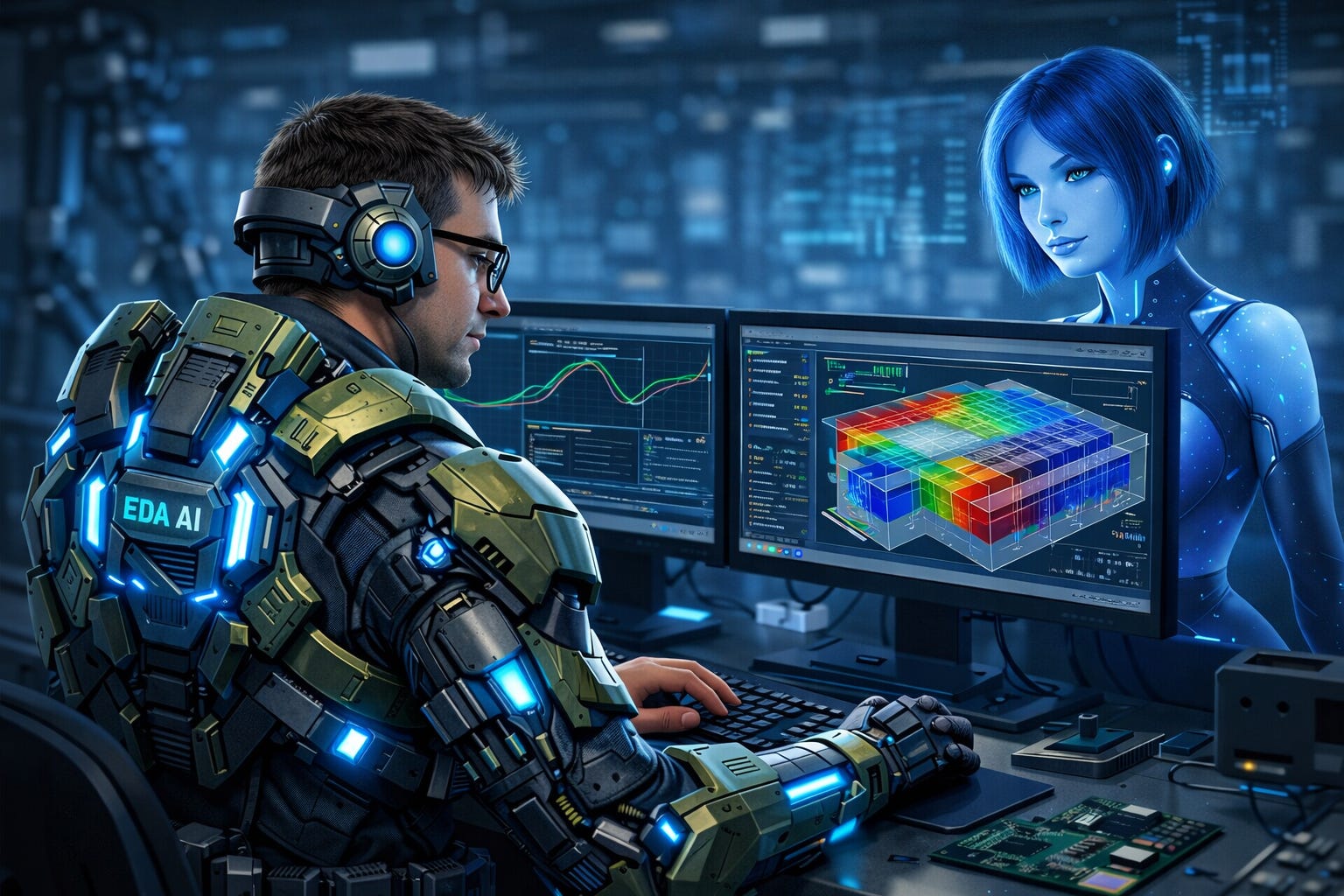
I have seen some new entrants in the market claim to have automated certain types of circuits like filters and amplifiers, but I believe that most elite Curmudgeons will conclude that the time savings are insufficient compared to their battle-tested design methodologies and strategies which, almost certainly, are not implemented in these new AI automations. Unless and until the Great Curmudgeon is outfitted with an AI-augmented “EDA exoskeleton” (think Master Chief and Cortana) that gives them super-human abilities to enhance their own proprietary workflows, I remain skeptical that many design firms will adopt these out-of-the-box AI automation tools.
The Real Opportunity
A chasm exists in the EDA world between the vision perpetuated by CEOs to shareholders and what the engineers are seeing in the design trenches. To be clear: I share the long-term vision that AI will eventually become a force multiplier in the world of EDA. However, outside of a few novel use cases, the reality is that AI has had almost no impact. Given that EDA companies will focus most of their efforts on improving advanced-node silicon design, I do not expect an AI revolution in RF design any time soon.
I expect steady progress, and I am optimistic about the next decade. Almost every engineer I know has dabbled in using ChatGPT or Claude to help them design. Automated script generation and multimodal LLM use cases can help RF design right now, hallucinations be damned. That said, the examples are tantamount to parlor tricks, not fully formed AI revolutions that will 10x an engineer’s capabilities—I predict progress will be slow and steady, not step-function.
I will leave you with a final observation: the engineering discipline, and especially new product development, is not isolated to the video-game activities of EDA design. New product development is a diverse and complicated process that touches countless people, software tools, and factory machines. At Marki Microwave, I would estimate that “design time” (i.e., the time spent in EDA tools developing new products) is no more than 25% of the total engineering effort. In other words, we spend three times as much money on “everything else”! New product development reaches far beyond Cadence, Synopsys, Keysight, and all the other EDA firms. As such, replacing all human designers with AI only reduces the overall new product development budget by perhaps 25%—and FYI, I can guarantee that if such AI tools existed, the budget would increase, not decrease…EDA firms are exceptional pricing strategists.
Tremendous opportunities emerge when entrepreneurs broaden their scope to treat the entire electronics product-development pipeline as their playground. Engineers tend to focus on the EDA part because that is where we focus our education, but the true economics of R&D and product development is much broader. Firms and startups should address bottlenecks and pain points that persist across the entire product-development ecosystem because the true benefit of AI is not in automating tasks, but in allowing for the re-bundling and seamless orchestration of those tasks (Reshuffle has a great discussion of this idea).